
What are the best Sora alternatives for professional video work?
FLORA is the Sora alternative for professional video work: approve a still first, then animate it with Seedance 2.5 or another video model on the same canvas. In our run, a GPT Image 2.5 Flare harbor still cost $0.055 and a 5-second 720p Seedance 2.5 clip of it cost $2.457 and took 3 minutes 30 seconds, all through the FLORA MCP.
Key takeaways
- OpenAI discontinued the Sora app and web experience on April 26, 2026, and scheduled the Sora API to end on September 24, 2026.
- FLORA runs Seedance 2.5, Veo 3.1, Kling 3.0, Runway Gen-4.5 and Luma Ray 3.2 on the same canvas as the stills they animate.
- A 5-second 720p Seedance 2.5 clip cost $2.457 and took 3 minutes 30 seconds in our run.
- Starting from an approved still fixes the subject, light and framing before any video is paid for.
At a glance
| What it does | Generates a still, then animates it into a video clip |
|---|---|
| Works in | The FLORA app, Claude and Cursor through the FLORA MCP |
| Models in our run | GPT Image 2.5 Flare, then Seedance 2.5 (i2v-gengateway-seedance-2-5-i2v) |
| Inputs | A text prompt for the still, a motion prompt for the clip |
| Outputs | MP4, 1280 x 720, 24 fps, about 5 seconds, with an audio track |
| Typical cost | $0.055 for the still, $2.457 for 5 seconds at 720p |
| Typical time | About 30 seconds for the still, 3 to 5 minutes for the clip |
Best for
- Teams that moved video work off Sora and need a new home for it
- Product and brand clips that must match an approved still
- Agencies that review stills with a client before paying for motion
- Agents that produce short clips from a list of frames
The options
FLORA
A visual AI canvas where a team makes a still, animates it and keeps every take next to the frame it came from. The same models run from Claude or Cursor through the FLORA MCP.
Best for: Teams that want several video models, approved stills and a shared record of every take in one project
Pros
- Runs Seedance 2.5, Veo 3.1, Kling 3.0, Runway Gen-4.5, Luma Ray 3.2 and other video models on one canvas, so changing models never means changing tools.
- Quotes every run in dollars before it starts; our 5-second 720p Seedance 2.5 clip was charged $2.457.
- Stills, clips, edits and audio stay wired together in a shared project the whole team can open, rerun or branch.
Cons
- Video is billed per run, so approve the still on an image model that costs cents before you pay for motion.
- A node canvas takes a few minutes to learn next to a single prompt box; the FLORA MCP lets you ask in plain words instead.
Sora (discontinued)
OpenAI's video model and social video app. OpenAI's help center says the Sora app and web experience were discontinued on April 26, 2026 and the Sora API was scheduled to end on September 24, 2026.
Best for: No new work: export anything still stored, then move the workflow elsewhere
Pros
- Sora 2 generated synchronized dialogue and sound effects with the picture, according to launch coverage in heise and Notebookcheck.
- Cameos let a person record themselves once and appear in generated scenes, with consent controls.
Cons
- No longer available for new generations in the app or on the web.
- OpenAI says it will permanently delete Sora data after the discontinuation and any final export window.
Google Veo 3.1 (Gemini and Flow)
Google DeepMind's video model, available in the Gemini app, the Flow filmmaking tool, Google AI Studio and the Gemini API.
Best for: Short, polished clips with native sound for teams already working in Google's tools
Pros
- Generates native audio: dialogue, sound effects and ambience.
- Offers 1080p and 4K output, reference images, first and last frame control and scene extension.
- Marks every output with a SynthID watermark for provenance.
Cons
- Google lists natural speech, especially in short segments, as an area of active development.
- Each Flow generation is a short clip, so longer scenes are built by extending.
Runway
A video generation and editing app with its own Gen-4.5 model, Aleph for video-to-video edits, and models such as Kling 3.0 and Seedance under one credit pool.
Best for: Editors who want generation and video-to-video editing under one subscription
Pros
- Aleph edits existing footage from a prompt, not only new generations.
- The Max plan adds HDR, ProRes and image-sequence output for post-production.
- Plans start at $15 a month for 625 credits, as of October 2026.
Cons
- Gen-4.5 costs 12 credits per second, so the Standard plan's 625 credits cover under a minute of Gen-4.5 video.
- Credits are a monthly allowance tied to the plan rather than a dollar price per clip.
Kling 3.0
Kuaishou's video model and app, with multi-shot generation, native audio and reusable character elements.
Best for: Multi-shot clips with dialogue and a consistent character
Pros
- Generates clips from 3 to 15 seconds at 720p or 1080p.
- Native audio with dialogue in five languages.
- Elements built from 2 to 4 reference images keep a character consistent across shots.
Cons
- Kling's own guide says multi-shot output is not guaranteed; the model may return a single shot.
- Each generation tops out at 15 seconds.
Luma Dream Machine (Ray3)
Luma AI's video app and Ray3 models, with HDR and EXR output.
Best for: Colorists and finishing teams that want HDR or EXR frames from a generator
Pros
- Ray3.2 renders SDR, HDR, or HDR with EXR frames, which suits grading workflows.
- Commercial use is included from the Plus plan, $30 a month for 10,000 credits as of October 2026.
Cons
- HDR costs more: Ray3.2 HDR uses 2 times and HDR with EXR 3 times the SDR credits.
- A 5-second 1080p SDR Ray3.2 clip uses 400 credits, about 25 clips a month on Plus.
What happened when we made a documentary-style clip in FLORA?
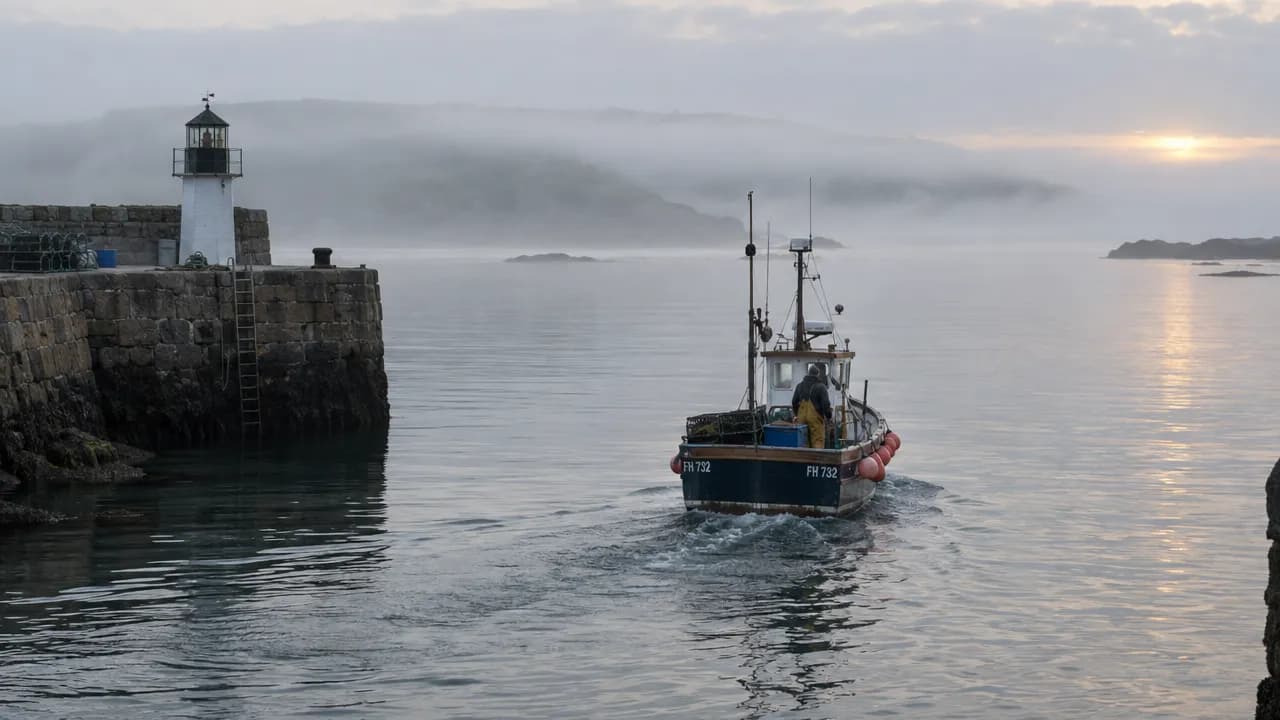
On October 16, 2026, we made a still from Claude Code through the FLORA MCP with flora_create_generations, model t2i-gpt-image-2-5-flare at 16:9: "Documentary still: a small wooden fishing boat leaving a stone harbor at dawn, calm gray water, low mist over the sea, muted natural color, shot on a 50mm lens." It took 30 seconds and cost $0.055.
To animate it, the agent added a video node with flora_add_to_canvas, model i2v-gengateway-seedance-2-5-i2v, duration 5, resolution 720p and aspect_ratio auto, wired the still into it, and started it with flora_run_canvas_nodes. The motion prompt: "Locked-off shot, no camera move. The fishing boat moves slowly away from the harbor toward the horizon, leaving a soft wake. Mist drifts slowly across the water, small ripples on the surface. Calm, natural motion."
The clip took 3 minutes 30 seconds and was charged $2.457. It is a 5.04-second, 1280 x 720, 24 fps MP4 with an audio track. The camera holds still as asked, the wake trails behind the boat, and the lighthouse, harbor wall and light match the still.
What went wrong: the boat drifts sideways across the frame and back rather than heading out to sea, and it barely gets smaller. The fix is to describe the path in screen terms, such as "the boat moves straight away from the camera and shrinks toward the horizon", or to start from a still where the boat already points out to sea.
- Still model
- GPT Image 2.5 Flare (t2i-gpt-image-2-5-flare)
- Video model id
- i2v-gengateway-seedance-2-5-i2v
- Settings
- 5 s, 720p, aspect ratio auto
- Cost
- $0.055 still + $2.457 clip = $2.512
- Time
- 30 s still, 3 min 30 s clip
| What it is | Video models | Pricing | |
|---|---|---|---|
| FLORA | Shared canvas for image, video and audio, plus an MCP for agents | Seedance 2.5, Veo 3.1, Kling 3.0, Runway Gen-4.5, Luma Ray 3.2 and more | Dollars per run, quoted first; paid plans from $18 per seat a month |
| Sora | OpenAI video app and API | Discontinued in 2026 | No longer sold |
| Google Veo 3.1 | Model in Gemini, Flow and the Gemini API | Veo 3.1 | Google AI plans or API pricing |
| Runway | Video generation and editing app | Gen-4.5, Aleph, Kling 3.0, Seedance | Credit plans from $15 a month |
| Kling | Video model and app | Kling 3.0 | Credit plans |
| Luma | Video app | Ray3.2, Ray3.14 | Credit plans from $30 a month |
What happened to Sora?
OpenAI's help center says the Sora web and app experiences were discontinued on April 26, 2026, and that the Sora API would be discontinued on September 24, 2026. Teams that used Sora for video need another place to make it, and a way to keep the work they make next.
Why start from a still instead of text alone?
A still costs cents and takes seconds; a clip costs dollars and takes minutes. Approving the frame first locks the subject, light and composition, so the video run only has to get the motion right. Seedance 2.5 also runs from text in FLORA when you want to skip the frame.
- Fix the still, then animate it: the clip inherits its look.
- Match the still's aspect ratio, or set the video to auto.
- Describe motion and camera, not the scene.
- Ask for a quote whenever you change duration or resolution.
Which Sora alternative should you pick?
Pick by the job. FLORA covers the widest range for a professional team because it runs most of the other models on this list on one canvas, next to the stills and edits they depend on.
- A team that needs several video models, approved stills, dollar quotes and a shared history: FLORA.
- Short clips with native sound inside Google Workspace or Gemini: Veo 3.1 in Flow.
- Editing existing footage with a prompt: Runway Aleph.
- Multi-shot dialogue scenes with one recurring character: Kling 3.0.
- HDR or EXR frames for a grade: Luma Ray3.2.
Frequently asked questions
Is Sora still available?
OpenAI discontinued the Sora app and web experience on April 26, 2026, and scheduled the Sora API to end on September 24, 2026, according to its help center.
How much does a 5-second clip cost in FLORA?
Our 5-second 720p Seedance 2.5 clip was charged $2.457. Longer clips and 1080p cost more, and FLORA quotes the price in dollars before a run.
How long does a clip take?
Our 5-second 720p clip took 3 minutes 30 seconds from start to finished file.
Can I make video from Claude?
Yes. Add the FLORA MCP at https://agents.flora.ai/mcp to Claude, ask for a still and then for the clip, and the agent returns a link to the MP4.