
Can AI make ad creative that doesn't look generic?
Yes, when the prompt carries a specific moment, place, lens and line of copy instead of a category. In FLORA we ran a one-line ad prompt and an art-directed one through GPT Image 2.5 Flare. The one-liner returned a stock-style runner with an invented brand and slogan; the directed prompt returned a scene you could pin to a mood board. Each cost $0.055.
Key takeaways
- Generic prompts give generic ads: "An ad for a running shoe brand" returned a stock-style runner, an invented logo and a slogan.
- An art-directed prompt naming a moment, place, lens and headline returned a specific scene with our headline set as asked.
- Each GPT Image 2.5 Flare image cost $0.055 and took 31 to 33 seconds.
- Our first directed image put a real-looking brand logo on the shoe; adding "no logos, no brand marks" fixed it.
At a glance
| What it does | Generates ad images and layouts from an art-directed brief |
|---|---|
| Works in | The FLORA canvas, or Claude, ChatGPT, Cursor and Codex through the FLORA MCP |
| Models | Image models in FLORA such as GPT Image 2.5 Flare, Ideogram 4.5 and Krea 3 |
| Inputs | A brief with a moment, setting, camera, light and headline, plus optional product photos |
| Outputs | PNG ad images; 864 x 1152 at 3:4 in our run |
| Typical cost | $0.055 per GPT Image 2.5 Flare image |
| Typical time | 31 to 33 seconds per image |
Key features
- Many image models: Run one brief through several models in FLORA and keep the strongest frame.
- Headline in the image: Models such as GPT Image 2.5 set short headlines in the frame when you give the exact words.
- Product references: Attach a product photo so the real product appears in the scene.
- Placement mockups: The flora-mockup-deck skill places a finished ad on billboards, shelters and social sizes.
Best for
- Paid social teams who need many distinct concepts a week
- Small brands without an art director on staff
- Testing several creative directions before a shoot
- Agencies building pitch work fast
Step by step
Step 1: Start from a moment, not a category
Pick one specific scene your customer lives through. A time of day, a place, a detail that tells the story.
Step 2: Art-direct the frame
Name the camera height, lens, light and what stays out of the frame. Say where the headline goes and give its exact words.
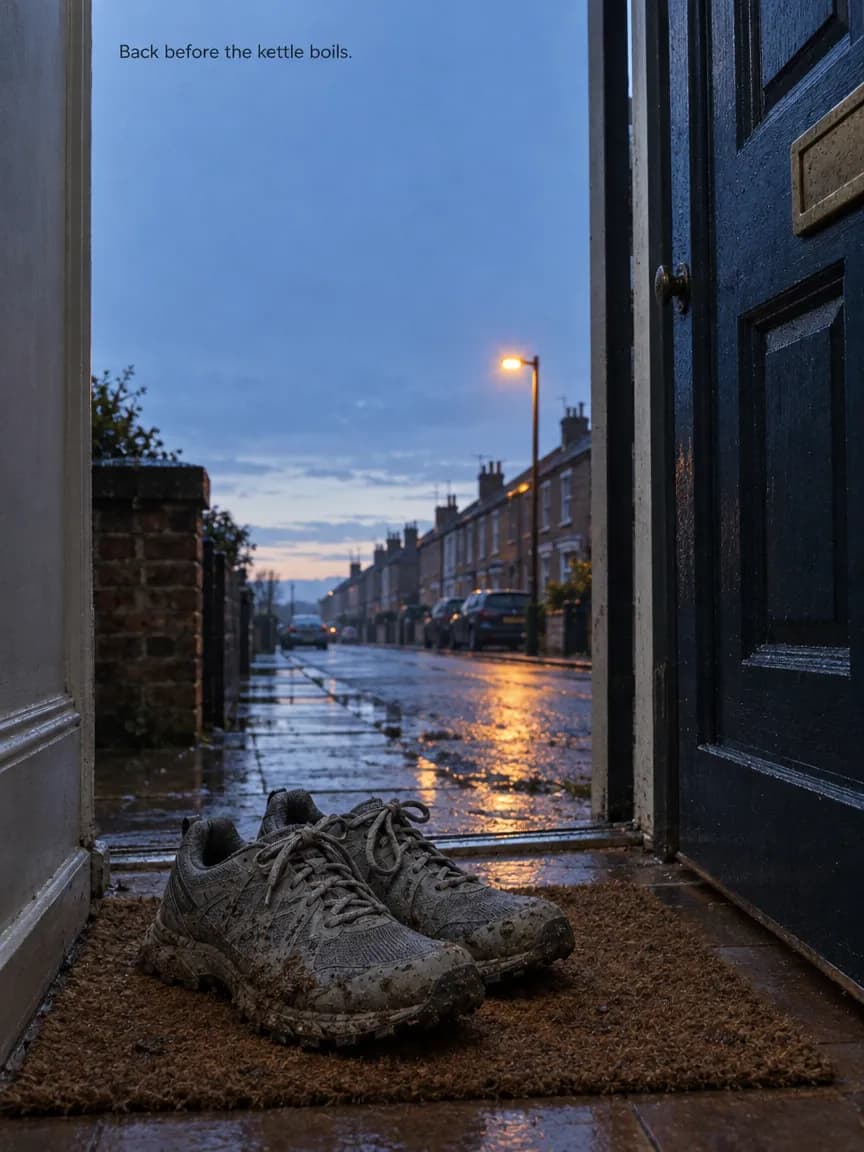
Social ad photograph, 3:4. A pair of mud-spattered plain grey trail running shoes with no logos, no brand marks and no text on them, laces still double-knotted, left on the doormat of a narrow terraced house at 6am, the front door half open onto a wet street lit by one sodium streetlight and the first blue of dawn. Shot from knee height on a 35mm lens, slight film grain, muted true-to-life color, no people. Clean empty space in the top third. Headline set small in a plain grotesk at top left: 'Back before the kettle boils.'Step 3: Check for borrowed marks
Zoom in on products, signs and clothing for logos or text you did not ask for. Rerun with "no logos, no brand marks" if any appear.
Step 4: Spin out variations
Keep the winning frame and change one thing at a time: the headline, the hour, the street. Run them as one batch.
What did a specific ad prompt produce in FLORA?
On October 16, 2026, we sent two prompts to t2i-gpt-image-2-5-flare in the same flora_create_generations batch. The first was one line: "An ad for a running shoe brand." The second was the art-directed brief from step 2, in an earlier version without the line about logos.
The one-line prompt came back in 32 seconds for $0.055 as a finished-looking ad: a runner mid-stride on a mountain trail, a made-up brand name and mountain logo, a bold headline reading MORE MILES. BIGGER DREAMS., three feature icons and a script sign-off. Everything in it was chosen by the model, and it looks like many other shoe ads.
The directed brief came back in 31 seconds for $0.055: muddy trail shoes on a coir doormat, a navy front door half open, a wet terraced street, one streetlight and a blue dawn sky. The headline sat small at top left, spelled as written.
What went wrong: the side of one shoe carried a logo that looked like a real running brand's. We could not use that frame. We added "plain grey ... with no logos, no brand marks and no text on them" and reran it: 33 seconds, $0.055, and the shoes came back unbranded with the rest of the scene intact. We asked for 4:5 on the one-line prompt; GPT Image 2.5 Flare has no 4:5 option and returned 3:4 at 864 x 1152, so we asked for 3:4 directly.
- Model
- t2i-gpt-image-2-5-flare
- Cost
- $0.055 per image, $0.165 for all three
- Time
- 31 to 33 s per image
- Images
- 1 one-line prompt, 1 directed brief, 1 rerun after the logo fix
| Result | One-line prompt | Art-directed brief |
|---|---|---|
| Scene | Runner on a mountain trail | Muddy shoes on a doormat at 6am |
| Brand | Invented name and logo | None, after the fix |
| Headline | MORE MILES. BIGGER DREAMS. (invented) | Back before the kettle boils. (ours) |
| Light | Bright daylight | Streetlight and blue dawn |
| Cost and time | $0.055, 32 s | $0.055, 31 s; rerun $0.055, 33 s |
One-line prompt or art-directed brief: pros and cons
Pros
- One-line prompt: useful to see what a model defaults to for a category.
- Art-directed brief: the scene, light and headline came back as written in our run.
- Art-directed brief: easier to vary one element at a time.
Cons
- One-line prompt: the model fills gaps with stock layouts, invented brands and slogans.
- Art-directed brief: takes a few minutes to write.
- Both: check every frame for logos and text you never asked for.
Why do AI ads look generic?
A model fills every gap in a prompt with the most common answer it knows. Ask for "an ad for running shoes" and the common answer is a runner on a scenic trail with a motivational headline. The fix is to leave fewer gaps: a moment, a place, a camera and the exact copy.
What should an art-directed ad prompt include?
Brief the model the way you would brief a photographer.
- One specific moment, with a time of day.
- The setting, down to a doormat or a streetlight.
- Camera height and lens.
- Light and color: muted, true-to-life, what light source.
- The exact headline and where it sits, or none.
- What must stay out: logos, people, text on products.
Can I see the ad in place before it runs?
Yes. The flora-mockup-deck skill takes a finished ad and places it on out-of-home sites and social sizes, without regenerating the creative.
Frequently asked questions
How much does an AI ad image cost?
Each GPT Image 2.5 Flare image in our run cost $0.055 and took about 32 seconds.
Can AI put my headline in the image?
Yes. Give the exact words and where they go. GPT Image 2.5 Flare set our headline correctly at top left. Check spelling on every frame before it runs.
Can I use my real product?
Yes. Attach a product photo as a reference and an image-to-image model places that product in the scene.
Why did a real brand's logo appear?
Models have seen many branded products and sometimes add marks on their own. Say "no logos, no brand marks" and check every frame.