
Can AI generate storyboards and animatics?
Yes. In FLORA you generate the first storyboard panel, then make every later panel from it as a reference, so the character and drawing style hold from shot to shot. The agent then lays the panels on a FLORA timeline with a music track and renders an animatic. Our four pencil panels cost $0.247, and the 10-second animatic rendered for $0.04 more.
Key takeaways
- Four storyboard panels cost $0.247 in our run: $0.055 for the first, $0.064 for each of the other three.
- Panels 2 to 4 used panel 1 as a reference and kept the same character, red scarf and pencil style.
- The three reference panels ran in parallel and finished 27 to 39 seconds after submission.
- The 10-second animatic, four panels plus a music track on a FLORA timeline, rendered for $0.04 in about 40 seconds.
At a glance
| What it does | Draws storyboard panels from a shot list and assembles them into an animatic |
|---|---|
| Works in | The FLORA canvas, or Claude, ChatGPT, Cursor and Codex through the FLORA MCP |
| Models | GPT Image 2.5 Flare for panels; the FLORA timeline (video editor) for the animatic |
| Inputs | A shot list or script, and a style for the first panel |
| Outputs | 1280 x 720 PNG panels; a 1280 x 720, 24 fps MP4 animatic with stereo sound |
| Typical cost | $0.055 to $0.064 per panel; $0.04 to render the animatic |
| Typical time | About 30 seconds per panel, panels in parallel; about 40 seconds to render |
Key features
- Reference panels: Every panel after the first is drawn from panel 1, so the character stays the same.
- Any drawing style: Pencil, marker, clean line or photographic frames, set by the first panel.
- Timeline editor: FLORA's timeline places panels in order with durations, titles and an audio track.
- Script to video skill: flora-script-to-video turns a script into a shot list, keyframes and clips, pausing for approval before each paid stage.
Best for
- Directors and agencies pitching a spot before a shoot
- Planning shots for a product or social video
- Animatics to time a voiceover or a music cue
- Getting a client to sign off on a sequence, not single frames
Step by step
Step 1: Write a numbered shot list
One line per panel: shot size, action, and anything that must carry over, such as a costume detail.
Step 2: Draw panel 1 and fix the style
Generate the first panel and adjust it until the character and style are right. Every other panel copies it.
Storyboard panel 1 of 4, rough pencil and grey marker storyboard sketch on white paper with a thin black panel border: wide shot of a young woman with short dark hair and a red scarf cycling along a canal path in light rain, city bridge behind her. Loose hand-drawn lines, no color except the red scarf, no text. 16:9.Step 3: Draw the rest from panel 1
Send the remaining panels together, each with panel 1 as the reference image.
Using panel 1 as the reference for character and style, draw panels 2 to 4 with FLORA, GPT Image 2.5 Flare, 16:9, same pencil style, same border, same character:
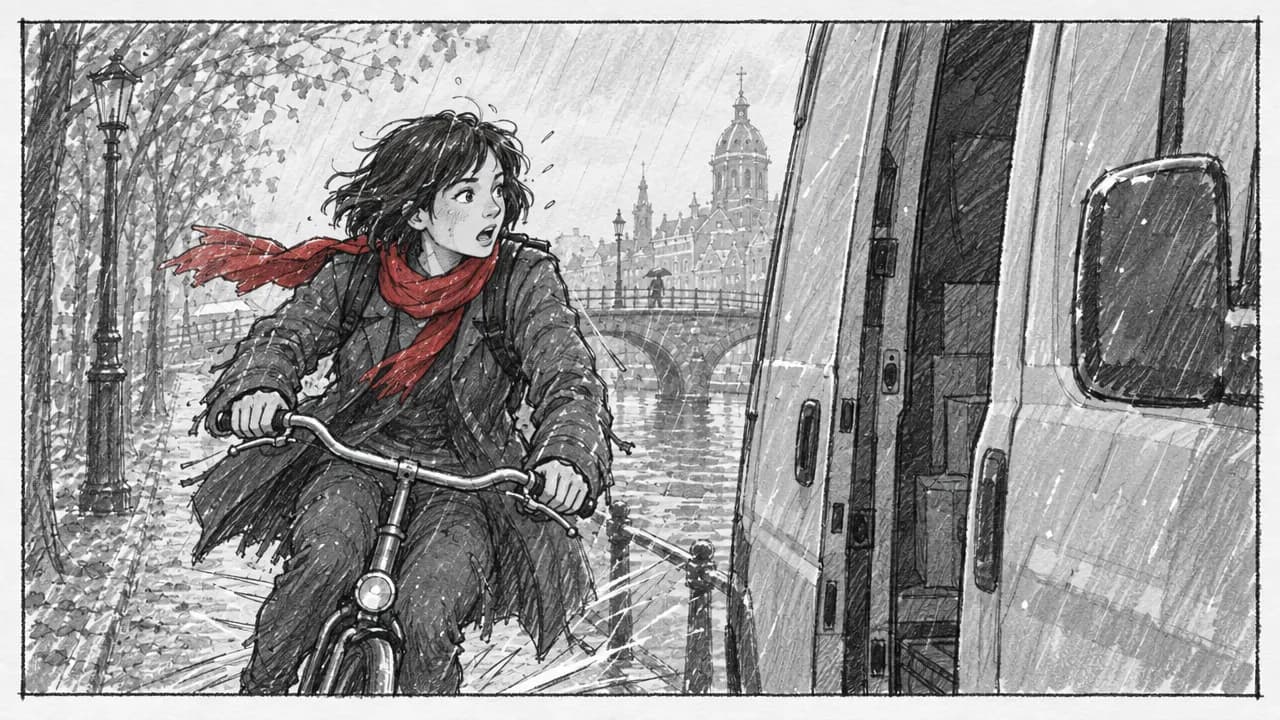
2. Medium close-up: she brakes as a van door swings open in front of her.
3. Close-up insert: her gloved hand catches a paper bag of oranges falling from the van.
4. Wide shot from behind: she rides away with the oranges in her basket, the driver waving.
Step 4: Time it as an animatic
Ask the agent to put the panels on a FLORA timeline in order, give each a hold time, add a music or scratch voiceover track underneath, and render. It writes one image item per panel, with lengths in frames.
Make an animatic from my four storyboard panels on a FLORA timeline: 1280 x 720 at 24 fps. Hold panel 1 for 3 seconds, panels 2 and 3 for 2 seconds each, and panel 4 for 3 seconds. Put the first 10 seconds of my music track on a second track under the picture. Render it and send me the MP4 link.
What happened when we made a storyboard and animatic in FLORA?
On October 16, 2026, the agent made panel 1 with t2i-gpt-image-2-5-flare at 16:9. It came back in 33 seconds for $0.055: a pencil sketch of a woman cycling along a wet canal path, red scarf the only color, an arched bridge and domed buildings behind.
The agent then sent panels 2 to 4 in one flora_create_generations call with model is2i-gpt-image-2-5-flare and panel 1's URL in params.image_urls. They finished 27 to 39 seconds after submission at $0.064 each. The set cost $0.247. Panel 2 shows her bracing on the bike as a white van door opens beside her; panel 3 is a close-up of her gloved hand catching a paper bag of oranges, one orange in the air; panel 4 shows her riding away along the canal while the driver waves from the van window.
Character and style held across all four: same hair, coat, red scarf, pencil hatching and border. The canal, bridge and skyline also carried over from panel 1 without being asked.
Then the agent cut the panels into an animatic. It called flora_add_to_canvas with one timeline node: 24 fps, 1280 x 720, a picture track with the four panels held for 72, 48, 48 and 72 frames (3, 2, 2 and 3 seconds), and an audio track with the first 240 frames of a Lyria 3.5 music track from our music guide. It started the render with flora_run_canvas_nodes and read the result with flora_list_generations. The render came back about 40 seconds later and was charged $0.04.
The file is a 10.05-second MP4: H.264 video at 1280 x 720 and 24 fps, with AAC stereo audio at 48 kHz. A frame strip taken every 1.5 seconds showed the four panels in order, full frame, with no cropping or letterboxing. The audio averages -23.5 dB, which matches the quiet opening of the music track.
What went wrong: we said the red scarf was the only color, and the oranges in panels 3 and 4 came out orange. In a storyboard that helps, since the bag is the story, but it broke the rule as written. Panel 3 was meant as a hand insert and also shows her face, so it reads as a medium close-up. The fix is to name every allowed color and to say what must stay out of frame, such as "hand and bag only, no face". On the animatic, the first flora_add_to_canvas call was rejected because the audio asset carried width, height and has_audio_track fields, which the timeline only accepts on video and image assets. Sending the audio asset with just its link, mime type and duration fixed it.
- Models and tools
- t2i-gpt-image-2-5-flare, is2i-gpt-image-2-5-flare, FLORA timeline
- Cost
- $0.247 for 4 panels, $0.04 for the animatic render: $0.287
- Time
- 33 s for panel 1, 27 to 39 s for panels 2 to 4 in parallel, about 40 s to render
- Output
- Four 1280 x 720 PNG panels and a 10.05 s MP4 animatic with sound
Still animatic or animated panels: pros and cons
Pros
- Still panels on a timeline: cents per panel, fast to reorder and retime.
- Still panels: the sketch look reads as a plan, so nobody mistakes it for final footage.
- Animated panels: show camera moves and action timing that stills cannot.
Cons
- Still panels: motion is implied, so complex action needs extra panels.
- Animated panels: each clip costs dollars and takes minutes.
- Animated panels: a sketch style can smear when a video model moves it.
What is the difference between a storyboard and an animatic?
A storyboard is the set of panels, one per shot. An animatic plays those panels in order with the timing of the final edit, usually with a scratch voiceover or music, so you can feel the pace before anything is shot or animated.
How do I keep the character the same in every panel?
Make every panel after the first from panel 1 as a reference image, not from text alone. Repeat the details that must carry over, such as the red scarf, in each prompt. If a panel drifts, rerun only that panel with a sharper note.
Can the panels become moving shots?
Yes. Any panel can go to a video model such as Seedance 2.5, which animates the frame it is given. Ask for a photographic keyframe from the panel first if you want the shot to look like footage rather than a moving sketch. Each clip costs dollars, so animate only the panels that need it.
Frequently asked questions
How much does an AI storyboard cost?
Our four panels cost $0.247 with GPT Image 2.5 Flare: $0.055 for the first and $0.064 for each panel made from it. Rendering them as a 10-second animatic cost $0.04 more.
How long does an animatic take to render?
Our 10-second, four-panel animatic with a music track came back about 40 seconds after the agent started the render.
Can it follow my script?
Yes. Give the agent the script and ask for a numbered shot list first, then approve the list before any panel is drawn. The flora-script-to-video skill runs that whole sequence.
Can I change the drawing style?
Yes. The first panel sets the style. Describe pencil, marker, clean line art or a photographic frame, and the later panels follow it.
Where do the panels live?
On your FLORA canvas, each one wired to panel 1, so you can redraw, reorder or animate any of them later.