
What is the best AI for storyboarding?
FLORA is the best AI for storyboarding when the boards need to turn into real shots. You describe each frame, FLORA draws all of them in one call, and a drifting frame is fixed by redrawing it with an earlier frame as the reference. Our four-frame pencil board cost $0.22, plus $0.064 for one fix.
Key takeaways
- Four 16:9 storyboard frames cost $0.055 each, $0.22 in total, sent in one call.
- Three frames finished in 41 to 44 seconds; one waited in a queue for 148 seconds.
- Frames drawn separately can drift: our courier lost his yellow jacket in two of four panels.
- Redrawing a frame with an earlier panel as the reference fixed the drift for $0.064 in 28 seconds.
- The board stays on a FLORA canvas, so any frame can become a finished still or a video shot.
At a glance
| What it does | Draws storyboard frames from shot descriptions and keeps them on one canvas |
|---|---|
| Works in | The FLORA app, plus Claude, ChatGPT, Cursor and other MCP clients |
| Model | GPT Image 2.5 Flare, text-to-image and image-to-image |
| Inputs | A shot list: framing, action and the character in each frame |
| Outputs | 16:9 frames at 1280 x 720, in any drawing style you name |
| Typical cost | $0.055 per frame, $0.064 per reference-based fix |
| Typical time | About 30 to 45 seconds per frame, in parallel |
Key features
- Whole board in one call: Up to 20 frames go to FLORA together and run in parallel.
- Reference-locked fixes: Redraw one frame from an earlier panel so the character, costume and style hold.
- Any drawing style: Pencil and marker, clean line, or photographic frames, set in the prompt.
- Boards to shots: Any frame on the canvas can go to a video model such as Seedance 2.5 or Kling for an animatic shot.
Best for
- Directors and agencies pitching a spot before a shoot
- Animatics that later become real shots
- Social and brand teams planning short video sequences
- Solo filmmakers who cannot draw fast enough
The options
FLORA
A visual AI canvas that draws every frame of a board, fixes drift with reference-based redraws, and turns frames into video shots on the same canvas. Agents such as Claude can build the board through the FLORA MCP.
Best for: Boards that need to become finished shots, in any drawing style, on one canvas
Pros
- A whole board in one call: our four frames cost $0.055 each and the fix cost $0.064, $0.284 in total.
- Reference-based redraws fix a drifting character: frame 4 redrawn from frame 2 got the yellow jacket back in 28.1 seconds.
- Frames go straight to video models such as Seedance 2.5 or Kling on the same canvas, so a board becomes an animatic without leaving the project.
Cons
- Characters can drift between frames unless every prompt repeats the description or uses a reference frame; two of our four frames drifted.
- Video shots cost dollars and take minutes each, so lock the board in stills first.
Boords
A pre-production platform for video agencies and their clients: scripts, storyboards, animatics and client sign-off, with AI image generation built in.
Best for: Agencies running storyboard reviews and approvals with clients
Pros
- Rich exports: PDF, MP4 animatic, DOCX, XLSX, Google Slides and a frame ZIP.
- Review tooling built for clients: permissions, unlimited guest commenting and comments hidden from clients.
- API and MCP access on all paid plans, plus Slack, Dropbox and Google Drive.
Cons
- Built around still frames and animatics; we found no AI video generation in its export formats.
- Paid plans start at $39 a month for Solo (as of October 2026).
LTX Studio
A script-to-storyboard-to-video studio from Lightricks that runs its own LTX models alongside third-party image and video models.
Best for: Filmmakers pitching a concept as a moving board
Pros
- Own LTX-2.5 and LTX-2.3 models plus FLUX.2, Nano Banana, Kling, Seedance 2.0 and Veo 3.1 (Veo on Pro).
- Storyboards and pitch decks come out of the same project as the video.
Cons
- Storyboards and pitch decks need the Standard plan ($35 a month as of October 2026) or above.
- Collaboration caps at 3 people per project below Enterprise.
Katalist
An AI creative studio for performance teams that turns a script into shots, a board and then video, using third-party models such as Runway, Veo, Kling and WAN.
Best for: Performance ad teams turning scripts into many short video variants
Pros
- Built for ads: product swap and character consistency across shots.
- Voiceover and lip-sync in the same flow, plus a Premiere Pro integration.
Cons
- Video export and the API are listed on the Enterprise plan only (as of October 2026).
| Tool | Pricing | Models | Outputs | Workflow | Team features | API and MCP |
|---|---|---|---|---|---|---|
| FLORA | Free plan; Starter $18, Pro $50, Max $200 per seat a month, usage at model rates | GPT Image 2.5, Nano Banana, FLUX and more; Seedance, Kling, Veo for video | Frames up to 4K, video shots, audio | Canvas, plus agents through the MCP | Real-time collaboration, shared projects and assets | API and MCP from Starter |
| Boords | Free (5 boards); Solo $39 to Agency $250 a month | Selectable image models, not named | PDF, MP4 animatic, Slides, DOCX, XLSX | Script to board, plus drawing | Client review, permissions, guest comments | API and MCP on paid plans |
| LTX Studio | Free credits; Lite $15, Standard $35, Pro $125 a month | LTX-2.5, LTX-2.3, plus FLUX.2, Kling, Seedance, Veo | Video, storyboards, pitch decks | Script to board to video | 3 collaborators per project; more on Enterprise | LTX API through sales |
| Katalist | Paid plans with a 7-day trial; Enterprise custom | Runway, Veo, Kling, Pixverse, WAN, LTX-2 | Boards, video, voiceover | Script to shots to video | Multi-seat on higher plans | API on Enterprise |
What happened when we storyboarded a script in FLORA?
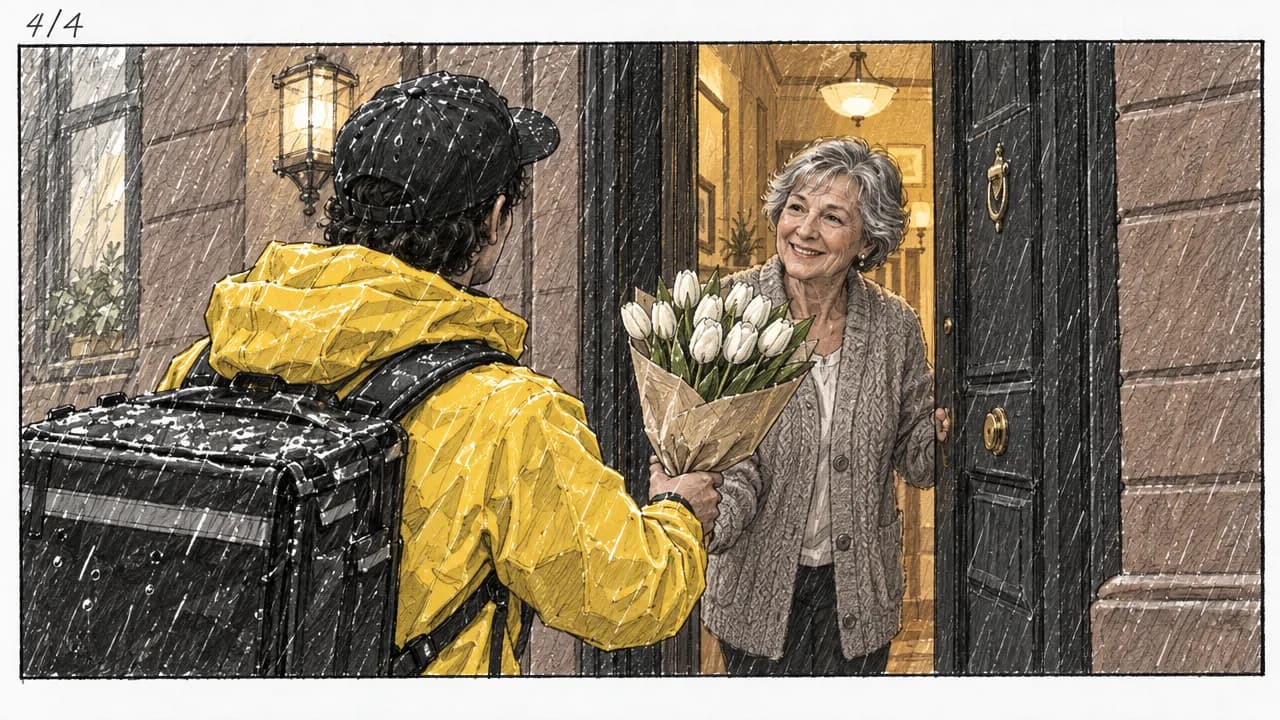
On October 16, 2026, we boarded a four-shot sequence: a bike courier in a yellow rain jacket delivers white tulips to a brownstone on a rainy evening. Each frame was one item in a single flora_create_generations call, model t2i-gpt-image-2-5-flare, quality high, 1K, 16:9. Every prompt opened with the same style line: "Storyboard frame N of 4, loose graphite pencil sketch with grey marker shading on white paper, thin black frame border."
The four shots were a wide establishing shot of the courier riding, a medium shot braking at the stoop, a close-up of gloved hands unstrapping the bouquet, and an over-the-shoulder handover at the door. Three frames finished in 41 to 44 seconds. Frame 1 sat in a busy queue and took 148 seconds. Each cost $0.055, so $0.22 for the board.
What went wrong: frames 3 and 4 did not repeat "yellow" in their prompts, and the courier came back in a dark jacket. Frame 4 also swapped the white tulips for pink ones. Frame 1 had warm color in the shop windows, against the grey of the rest.
The fix: we redrew frame 4 with model i2i-gpt-image-2-5-flare, frame 2 as the reference node, and the full costume repeated in the prompt. It came back in 28.1 seconds for $0.064 with the yellow jacket, the black delivery backpack and white tulips. Total for the board and the fix: $0.284.
- Model
- GPT Image 2.5 Flare (text-to-image, then image-to-image)
- Tools called
- flora_create_generations, flora_list_generations
- Cost
- $0.284 for 4 frames and 1 fix
- Time
- 28 to 148 s per frame, in parallel
| Frame | Shot | Time | Cost | Drift |
|---|---|---|---|---|
| 1 | Wide, courier riding down a rainy street | 148 s (queued) | $0.055 | Warm color in shop windows |
| 2 | Medium, braking at the stoop | About 44 s | $0.055 | None |
| 3 | Close-up, unstrapping the bouquet | About 43 s | $0.055 | Dark jacket instead of yellow |
| 4 | Over the shoulder, the handover | About 41 s | $0.055 | Dark jacket, pink tulips |
| 4, fixed | Redrawn from frame 2 | 28.1 s | $0.064 | Fixed |
How do I keep the same character across every frame?
Write the character once and paste it into every frame's prompt, word for word: clothing, colors, props. Our drift came from two prompts that skipped the jacket color.
For a longer board, draw one frame first, then generate the rest image-to-image with that frame as the reference. The model sees the character every time, not a description of it.
What should each frame's prompt include?
Keep one shared style line, then one line per shot.
- The frame number and the style: pencil, marker, clean line or photographic.
- The framing: wide, medium, close-up, over the shoulder.
- The action in one sentence.
- The full character description, repeated.
- Any arrow or camera move you want drawn on the frame.
Can the board become an animatic?
Yes. On the FLORA canvas, wire any frame to a video model such as Seedance 2.5 or Kling to make a short shot from it. Pencil frames animate as pencil; for a live-action look, first redraw the frame image-to-image as a photographic still.
Which AI storyboarding tool should you pick?
Pick by where the board goes next. If the frames are meant to turn into real shots, keeping both on one canvas saves the most time.
- A board in any style that becomes an animatic or finished shots: FLORA.
- A board built by Claude or Cursor from a script: FLORA through the MCP.
- Formal client sign-off with PDF and Slides exports: Boords.
- A pitch deck and moving board from one script: LTX Studio.
- Many short ad variants from one script: Katalist.
Frequently asked questions
How much does an AI storyboard cost?
Our four-frame board cost $0.22 on GPT Image 2.5 Flare, plus $0.064 for one fix.
Can I draw the board from a script?
Yes. Paste the script into Claude or ChatGPT with the FLORA MCP connected and ask for a shot list and a frame per shot. The agent sends every frame to FLORA in one call.
Can I choose the drawing style?
Yes. Name it in the shared style line, such as pencil and grey marker, clean ink line, or photographic.
Why did my character change between frames?
Each frame is drawn on its own. Repeat the full description in every prompt, or redraw drifting frames with an earlier frame as the reference.