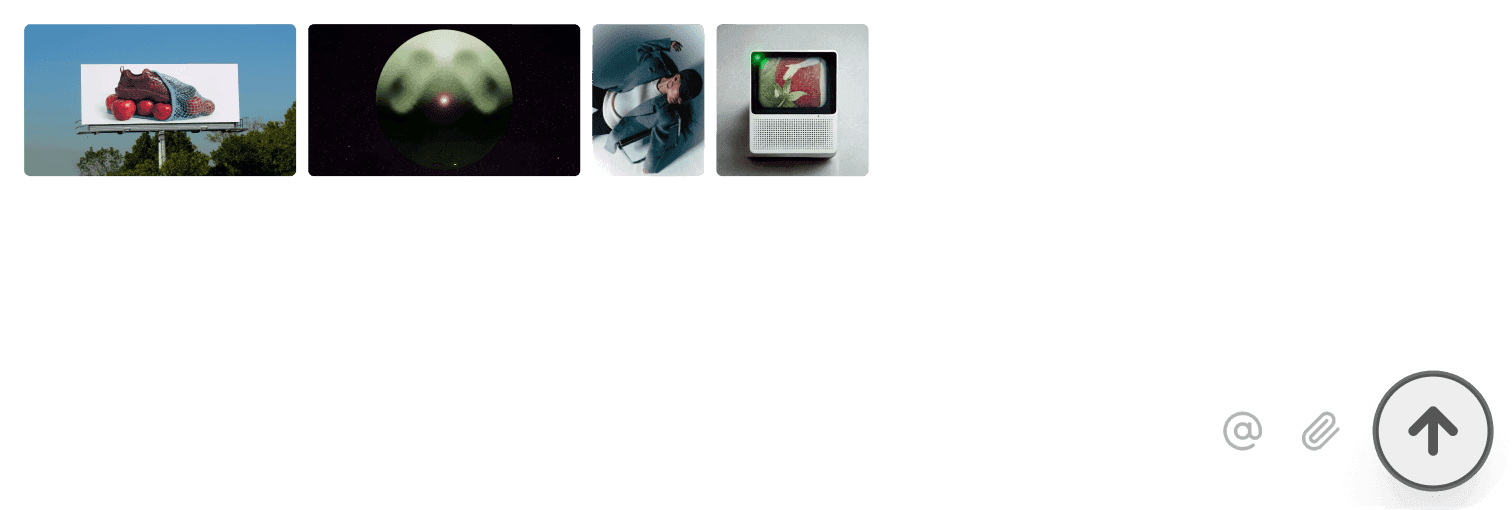
The Creative AI Adoption Curve
A living guide to creative AI adoption, from the FLORA team.
How to read this guide
The creative teams doing the best work treat AI the way a painter treats a brush: picked up for a particular job, finish, or need, and set down when the work calls for another.
We set out to write a playbook for our own customers, and what we ended up crafting looks less like a ladder and more like a volume knob: set per task, and turned in both directions. After all, we don’t believe the best work is correlated with maximum AI use; rather, it’s all about the best tool for the job.
Technology will keep changing, and so will this guide. Below are the six settings on the AI dial, complete with a note from our Forward Deployed Creatives based on what they've observed.

01 Hand-made
Hand-made stays wherever authorship is part of the meaning. It's often for two reasons: because the audience needs it that way, or because you do.
Use it for Hero assets or primary imagery where craft is the whole point and volume is low, e.g., a flagship campaign film, a founder portrait, or a single image on which a visual or campaign system relies.
Dial up the AI when The quarterly volume doesn't fit inside what team can produce. Start with the work that truly doesn't need a shoot.
FDC note Hand-made doesn't automatically mean maximum human thinking, as things we were doing manually didn’t necessarily have our mind in/on it (cue: background remover). Ideally, thinking remains intact through all levels, and is reserved for the most important, joyful parts of creating, and not on the painful, manual ones.
02 Human-led, AI-assisted
AI works beside you on isolated tasks while you make the asset. You give it a prompt in a separate tool or inside your editor, and it hands back raw material you react to and finish manually.
Use it for Mood boards, concept exploration, visual directions, headline and copy variations, quick mockups to get stakeholder buy-in before a shoot.
Dial up the AI when You want generated work going out the door, built from your real source material, and you're ready for the review load that arrives with it.
Dial back the AI when The directions start looking like a model preference (Nano Banana, for example) instead of twelve different worlds, if you're converging on the same aesthetic too early, or the sketching muscle is visibly atrophying. Two days of hand-made work can fix what another hundred generations won't.
FDC note Be brutally honest about what "AI-assisted" actually means, which is you thinking, but faster. Set the ground rules now, while nothing's at stake: which tools are approved, what generated work can and can't be used for, who signs off, and how you'll keep a record of what was made with what. Also, make sure to keep the early work rough on purpose: a too-finished render gets treated like a decision, or a stakeholder who signs off on the comp and expects that exact image. The whole value of this level is staying uncommitted a little longer than feels comfortable.
03 AI-drafted, Human-assisted
The relationship flips: AI produces and you correct. A real shoot goes in, and the campaign's whole variation set comes out, thirty from one hero in an afternoon. The second half of the afternoon is fixing the eleven that missed.
Use it for Resizes and reformats across channels, recoloring, background swaps, seasonal and regional variants of a hero you made.
Dial up the AI when Twenty generations with your brand context loaded come back mostly approvable, untouched, and your instinct tells you that the production phase is near.
Dial back the AI when You're spending more time fixing variations than you would have to make ten by hand. Or, the product keeps breaking in generation, the seams sit wrong, the drape looks wonky, the color's a shade off, and no amount of correcting saves it. It's a sign to send that work back to the shoot, let AI help with the thinking instead, and try again when the tools can meet your quality bar.
Editor's note Pay close attention to what happens to your team's time, even if production time speeds up. The primary reason teams stall here is because they didn't properly invest in loading context into their AI tools. Without insight into your brand kit, references, and the range of creative decisions you've made, the models make assumptions that often miss. This stage is one where you want to spend maximum time on loading in your context into your tool of choice, and keep tweaking so the tool learns before you've gone too far down the path.

04 Human-directed, AI-produced
You hand the system one approved campaign and direct its full rollout, down to the channel and format. You don't review every asset, but you do document what good looks like so the system flags anything that misses.
Use it for Net-new product imagery inside a known category, product and garment views from a prompt, short video from stills, assets flowing directly into e-commerce and paid.
Dial up the AI when You've been approving a category of work at checkpoints for months and rarely need to change anything, and you want the system producing across every channel and region at once while you direct.
Dial back the AI when If/when the quality checkpoints surface fundamental problems, or if the models aren't keeping up with key context changes. Trust in AI generation is slowly earned at every step, and it can be lost the same way.
Editor's note The strange thing about this level is that nothing is materially different. What's new is trust, which is earned rather than hoped for, because the stage literally cannot run without governance (context loaded, checkpoints defined, rights cleared, an audit trail of what generated and who approved). This is also when you'll see production, resource, and budget shifts (for the better).

05 Orchestrated
You hand AI an approved campaign, and it makes every version the campaign needs: every channel, every region, every format. Instead of reviewing every asset, you set the standard and AI flags where assets fall short.
The big shift here is the altitude at which you're operating. In a pure orchestration world, the jobs-to-be-done are packaged into systems that you tune at the context layer. Many campaigns run at once, each self-checking against your context, and so your focus stays at the system, not asset, level.
Use it for Multiple campaigns — or an always-on content engine — running in parallel, each self-checking, with only the questionable assets surfaced for your judgment call.
Dial up the AI when The same setups keep recurring and you catch yourself tuning what the system flags rather than ruling on assets.
Dial back the AI when The flags start piling up: the work isn't meeting your quality bar, the brief shifted in a big way, or it's an important enough launch that needs eyes on every pixel.
Editor's note The most useful habit at this level is to make your taste explicit. Every time you rule on a flagged version, note why (or why not). Those intangible decisions become your written definition of good and what AI needs to truly know your brand. Years of brand context and recorded decisions is real property: know where it lives, make sure it moves with you if you ever leave the platform, and confirm nobody's models learn from your work. You're building something worth owning.

06 Encoded
The whole brand is encoded as a machine-readable system: positioning, voice, audience, color, type, components, and motion, all structured so any agent can read it and build from it. The brand is a living system, where assets, pages, and campaigns generate downstream from it and inherit its logic.
Use it for A brand any team or agent can build from and stay on brand, a system that produces a coherent landing page, UI, or campaign from a single prompt, a living brand that updates everywhere when you change one value at the source.
Move back when A workflow loses its owner, or its outputs drift and nobody catches it. It also means holding off on encoding the full brand mid-move (e.g., a repositioning, a merger, a new identity taking shape), and systematize after the dust settles.
Editor's note Somebody on your team is already at this level unofficially (the private plugin, the automated step, the agent in Slack, the script everyone quietly borrows); this level just does it on purpose, with owners and standards. Tending your encoded workflows should feel like managing a garden, as they're akin to living organisms that change with your business. One new question arrives with that: once your agents, your agencies', and your partners' are all generating from the system, who keeps it coherent with the creative intent? Ask how agent access gets governed. It's contract language now.