"/><stop offset="1" stop-color="rgba(15, 15, 15, 0)"/></linearGradient></defs><path d="M 899.729 124.429 L 931.177 124.429 L 931.177 108.467 L 946.905 108.467 L 946.905 44.616 L 884.001 44.616 L 884.001 92.504 L 868.274 92.504 L 868.274 124.429 L 852.554 124.429 L 852.554 140.392 L 836.826 140.392 L 836.826 156.355 L 852.554 156.355 L 852.554 172.317 L 836.826 172.317 L 836.826 204.242 L 821.098 204.242 L 821.098 236.168 L 852.554 236.168 L 852.554 252.129 L 758.2 252.129 L 758.2 236.167 L 789.65 236.167 L 789.65 204.241 L 805.378 204.241 L 805.378 172.316 L 821.098 172.316 L 821.098 124.428 L 836.826 124.428 L 836.826 92.504 L 852.554 92.504 L 852.554 44.616 L 836.826 44.616 L 836.826 28.654 L 962.625 28.654 L 962.625 44.616 L 978.353 44.616 L 978.353 60.579 L 994.081 60.579 L 994.081 76.541 L 978.353 76.541 L 978.353 124.429 L 946.905 124.429 L 946.905 140.392 L 931.177 140.392 L 931.177 156.355 L 946.905 156.355 L 946.905 236.168 L 978.417 236.168 L 978.417 220.205 L 994.145 220.205 L 994.145 204.242 L 1009.865 204.242 L 1009.865 188.28 L 1025.593 188.28 L 1025.593 204.242 L 1009.865 204.242 L 1009.865 220.205 L 994.145 220.205 L 994.145 236.168 L 1025.593 236.168 L 1025.593 252.13 L 915.449 252.13 L 915.449 156.355 L 899.729 156.355 Z M 1135.672 172.317 L 1119.944 172.317 L 1119.944 76.541 L 1104.216 76.541 L 1104.216 92.504 L 1088.496 92.504 L 1088.496 108.467 L 1072.768 108.467 L 1072.768 92.504 L 1088.496 92.504 L 1088.496 76.541 L 1104.216 76.541 L 1104.216 60.579 L 1119.944 60.579 L 1119.944 28.654 L 1135.672 28.654 L 1135.672 60.579 L 1151.392 60.579 L 1151.392 236.168 L 1167.12 236.168 L 1167.12 252.13 L 1104.216 252.13 L 1104.216 236.168 L 1119.944 236.168 L 1119.944 188.28 L 1135.672 188.28 Z M 1072.768 124.429 L 1072.768 140.392 L 1057.041 140.392 L 1057.041 156.355 L 1041.321 156.355 L 1041.321 172.317 L 1025.593 172.317 L 1025.593 156.355 L 1041.321 156.355 L 1041.321 140.392 L 1057.041 140.392 L 1057.041 124.429 Z M 176.61 25.988 C 124.406 25.988 78.864 38.954 68.867 80.108 C 64.424 102.095 70.533 130.282 105.522 145.504 C 107.678 146.379 109.332 146.83 110.516 147.152 C 112.382 147.661 113.082 147.852 112.742 148.886 C 112.186 150.577 106.633 150.014 102.19 148.323 C 69.424 136.484 51.65 107.168 54.983 77.289 C 60.536 35.572 109.966 -1.636 179.387 0.056 C 202.713 0.056 238.812 5.692 273.246 15.276 C 293.795 20.914 321.009 28.243 346.555 34.444 C 369.881 24.86 392.096 18.659 411.534 18.659 C 425.628 18.659 438.846 21.919 444.414 28.654 L 537.86 28.654 L 537.86 44.616 L 506.41 44.616 L 506.41 60.579 L 490.685 60.579 L 490.685 92.504 L 474.959 92.504 L 474.959 124.429 L 459.233 124.429 L 459.233 172.317 L 443.508 172.317 L 443.508 220.205 L 427.783 220.205 L 427.783 236.168 L 522.135 236.168 L 522.135 220.205 L 537.86 220.205 L 537.86 204.242 L 553.586 204.242 L 553.586 172.317 L 569.311 172.317 L 569.311 204.242 L 553.586 204.242 L 553.586 236.168 L 537.86 236.168 L 537.86 252.13 L 364.881 252.13 L 364.881 236.168 L 396.332 236.168 L 396.332 220.205 L 412.058 220.205 L 412.058 172.317 L 427.783 172.317 L 427.783 140.392 L 443.508 140.392 L 443.508 92.504 L 459.234 92.504 L 459.234 44.616 L 444.157 44.616 C 437.338 52.415 419.206 55.303 394.318 55.303 C 379.323 55.303 357.108 53.048 349.333 51.92 C 337.67 63.196 325.452 77.853 314.9 90.82 C 305.307 102.032 297.996 111.856 290.818 121.501 C 284.281 130.284 277.855 138.919 269.914 148.323 C 283.798 148.886 298.794 147.759 309.901 143.812 C 320.454 129.155 333.783 122.39 342.669 124.645 C 351.554 126.9 350.444 135.92 337.67 145.504 C 335.4 147.26 333.256 148.887 331.193 150.453 C 322.659 156.932 315.515 162.356 306.569 171.436 C 304.66 173.374 302.994 175.312 301.571 176.968 C 299.269 179.646 297.602 181.584 296.572 181.584 C 293.24 182.148 294.351 172 296.572 166.363 C 299.349 159.597 302.126 154.524 304.903 150.577 C 295.462 153.396 284.91 154.524 266.026 154.524 C 264.938 155.812 263.791 157.222 262.545 158.751 C 259.978 161.904 256.993 165.569 253.253 169.745 C 204.381 225.557 123.85 256 71.645 256 C 29.993 256 0 239.087 0 212.591 C 0 193.987 12.774 175.947 34.99 175.947 C 53.317 175.947 61.092 188.349 60.537 200.188 C 59.981 208.644 57.204 213.718 51.651 219.92 C 47.763 224.429 44.431 228.376 44.431 234.013 C 44.431 243.597 52.762 249.798 68.867 250.362 C 111.631 253.181 142.177 234.013 176.61 195.678 C 190.494 180.456 200.491 168.054 210.488 153.96 C 198.27 153.96 186.607 153.96 179.943 154.524 C 172.902 154.799 168.37 155.744 165.639 156.313 C 162.768 156.912 161.886 157.096 162.17 155.652 C 162.726 153.396 167.724 149.45 184.385 148.323 C 188.537 147.94 196.791 148.077 204.443 148.204 C 208.052 148.264 211.528 148.323 214.375 148.323 C 222.151 137.611 231.037 125.772 242.7 113.37 C 264.915 89.128 294.35 65.451 323.23 47.411 C 307.124 45.719 281.021 40.645 263.804 37.263 C 239.923 32.753 203.268 25.988 177.166 25.988 L 176.61 25.988 Z M 365.438 39.518 C 386.542 45.156 403.204 46.847 413.2 46.847 C 427.64 46.847 440.969 42.336 441.524 36.136 C 442.08 29.37 428.751 24.296 410.979 24.296 L 410.423 24.296 C 394.317 24.296 375.435 32.753 365.438 39.518 Z M 711.023 252.129 L 616.672 252.129 L 616.672 236.167 L 600.946 236.167 L 600.946 220.204 L 585.221 220.204 L 585.221 108.466 L 600.946 108.466 L 600.946 76.54 L 616.672 76.54 L 616.672 60.578 L 632.396 60.578 L 632.396 44.616 L 663.847 44.616 L 663.847 28.654 L 758.2 28.654 L 758.2 44.616 L 773.924 44.616 L 773.924 60.579 L 789.65 60.579 L 789.65 172.317 L 773.924 172.317 L 773.924 188.28 L 758.2 188.28 L 758.2 220.205 L 742.474 220.205 L 742.474 236.168 L 711.023 236.168 Z M 663.847 44.616 L 663.847 60.579 L 648.122 60.579 L 648.122 76.541 L 632.396 76.541 L 632.396 108.467 L 616.672 108.467 L 616.672 220.205 L 632.396 220.205 L 632.396 236.168 L 695.298 236.168 L 695.298 220.205 L 711.023 220.205 L 711.023 204.242 L 726.749 204.242 L 726.749 188.28 L 742.474 188.28 L 742.474 156.355 L 758.2 156.355 L 758.2 60.579 L 742.474 60.579 L 742.474 44.616 Z" fill="url(%23k7ftP17bN-2050371890-linear-gradient)" height="255.9995555606772px" id="k7ftP17bN" width="1167.1199228535695px"/></svg>)
Architecture with LMN and FLORA
Architecture with LMN and FLORA
Architecture with LMN and FLORA

FLORA
Ask architects what worries them about AI and the answer is rarely their jobs. It's the buildings. It's the floor-plan generators and one-click renderers that flatten design into interchangeable, developer-grade boxes, waved through for the sake of speed.
Bryant Callahan has heard that fear plenty. He runs the tech studio at LMN Architects, and his response runs the other way. "We don't want to compress so we can do more projects. We want to improve the quality of work on the projects we have. This lets us actually design."
That tracks with how the Seattle-based LMN operates. They were early on 3D printing, CNC fabrication, and computational design, usually before the rest of the industry moved. "Architecture and engineering tends to lag," Bryant says. "It's so governed by construction, and construction is risk-averse." LMN's instinct runs the other way: try the thing while it's still a little risky, then work out what it's actually for.
LMN can afford that instinct because of what it's achieved: nearly 300 design awards, the 2016 AIA Architecture Firm Award, and a portfolio that runs from the Washington State Convention Center expansion to the Seattle Aquarium's Ocean Pavilion. Architecture, urban design, landscape, interiors, and public art all sit in one studio and turn up on every project. Clients come to LMN when a building has to carry a lot of cultural weight at once, which as it turned out, put a lot of pressure on rendering.

Clients see something as it is
Civic projects generate an enormous amount of visualization. Schematic design runs for months, and at every milestone a team has to turn a still-changing idea into something a city council or a museum board can react to.
For decades, the process worked one way. You designed in 3D, modeled in Enscape or Revit, then late and under deadline, two specialists in 3ds Max produced a polished image for the presentation. It worked, but it also created three problems:
Rendering came too late to act on
Lean teams couldn't afford it
Early polish froze decisions before they were made.
"Clients can immediately start asking, why are the lights like this? Why is the ground like this?" Bryant says. "Designers understand everything is malleable. Clients see something as it looks, in that moment."
A finished-looking render at the schematic stage pulls the conversation toward finishes and polish, when it should still be about feeling, scale, and intent. LMN had been chipping at this for years, cycling through all the node-based tools (ComfyUI, etc) and Midjourney back when it was a Discord channel. None stuck. Local models were unstable under deadline, and most generative tools were black boxes: type a prompt, get an image, which is the opposite of how a design team thinks.
Why FLORA held up
Two things made the difference, and both are less glamorous than they sound.
First was reliability. "We're at a deadline," Bryant says. "You want something that opens up and just runs." It's the boring prerequisite for any tool entering a professional workflow, and where most generative tools fall down.
Second was fit. FLORA adapted to how the studio already worked, instead of the reverse. Jeff, a designer in the studio, became one of the first power users by sketching instead of typing prompts, using a hand drawing as the fastest way to tell the tool what he meant. When the team flagged that copy-paste was clunky, it got fixed. When Jeff's sketch-over method took hold, FLORA leaned into it.
"Picking software often feels like picking the least-worst option," Bryant says. "It's nice to feel like our input had an impact, and that there's recognition of the unique way we work."
Feeling the magic of FLORA
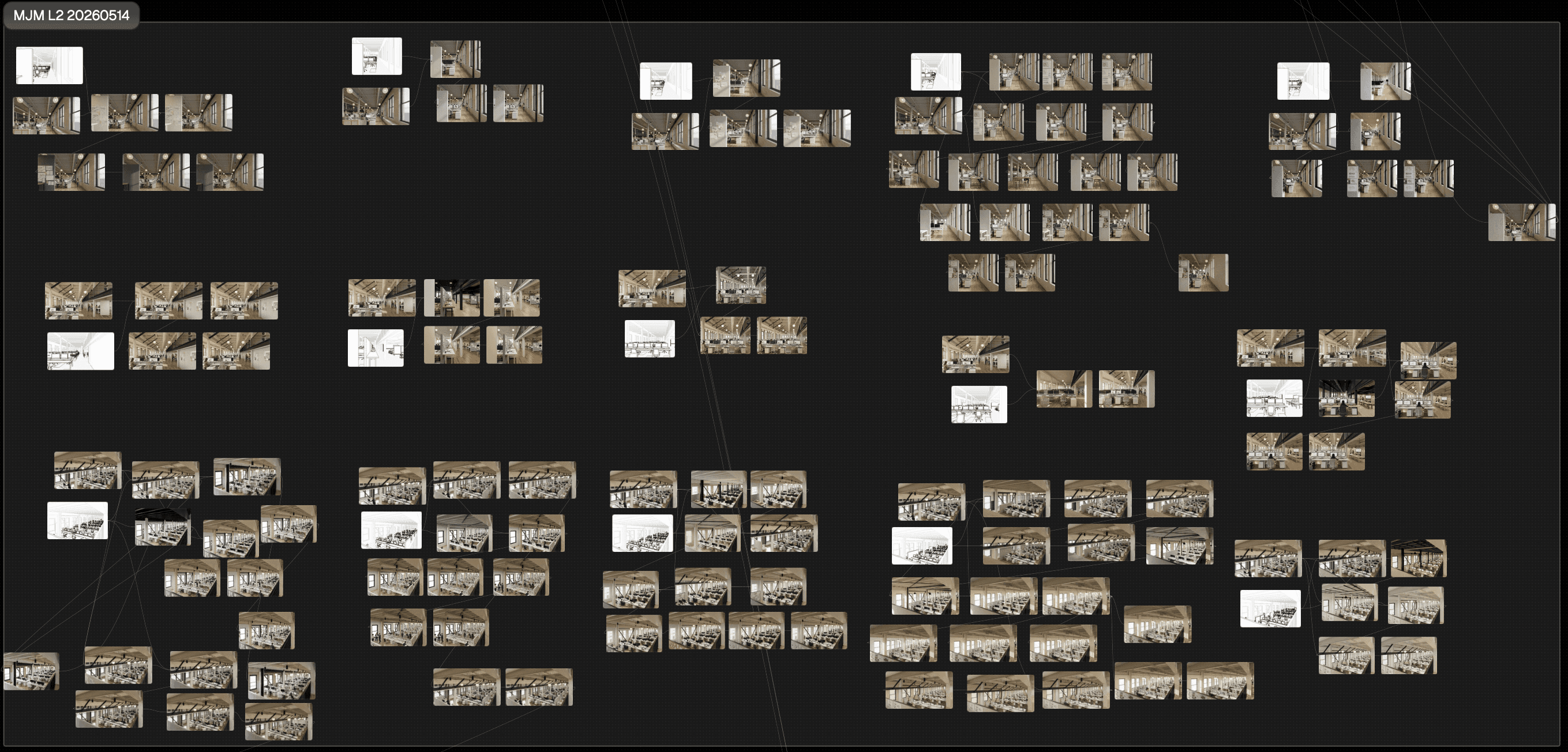
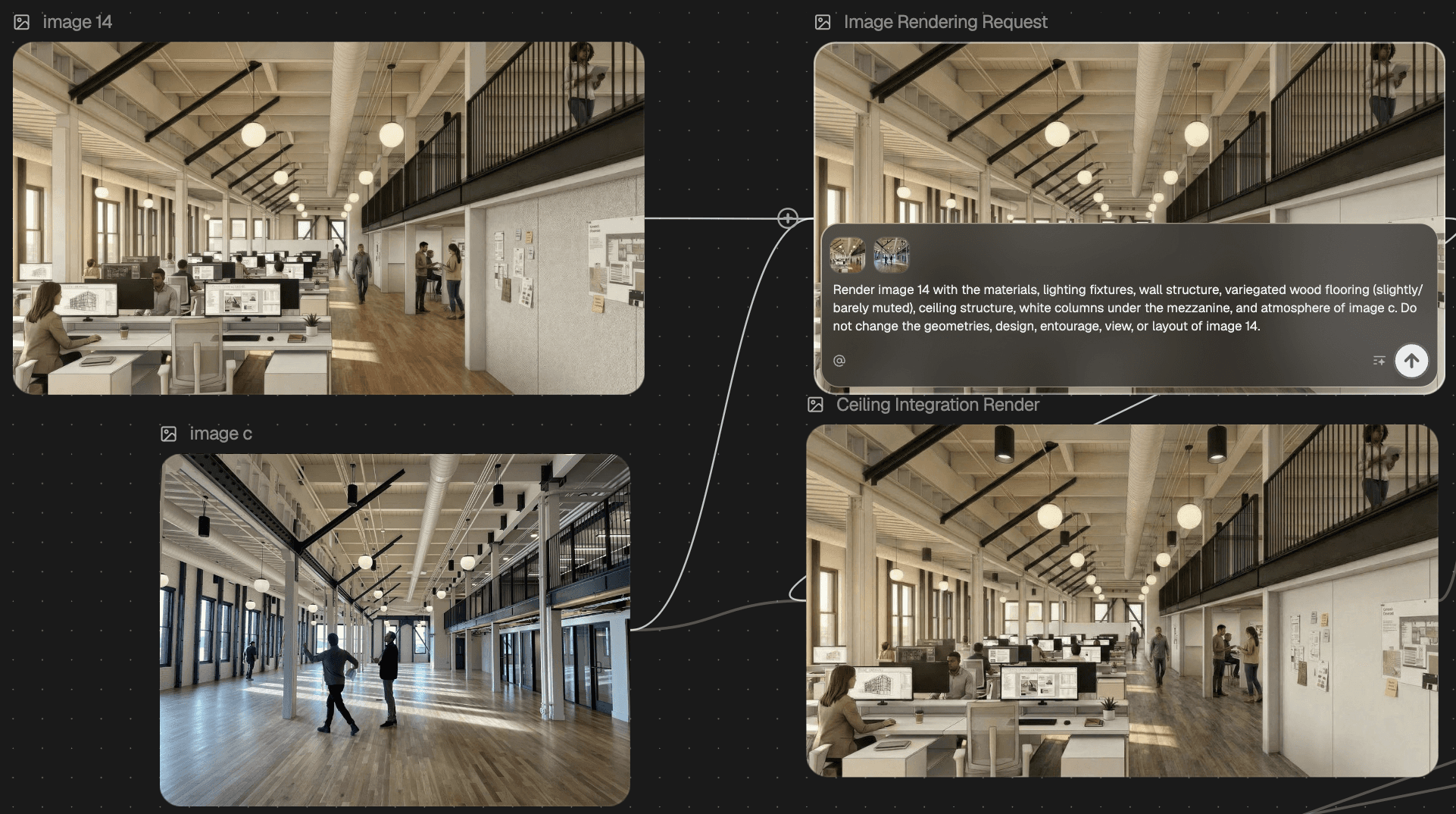
Jeff's process is a loop. He exports a clay model from Enscape, sketches over it (by hand, in Photoshop, sometimes with a finger on his phone) to suggest material, light, or a specific move, then feeds it into FLORA and prompts through a few iterations. Sometimes it ends there, with an internal render that gets the team aligned. Other times it runs back through Photoshop and FLORA again before going to the client. "It's not a linear workflow," Jeff says. "There's a start and an end, but a lot of looping back in between."
Bryant frames it as "multimodal by design": model, export, sketch, render, print, mark up, re-model. "You gain design insight by changing from one form to another and back again."
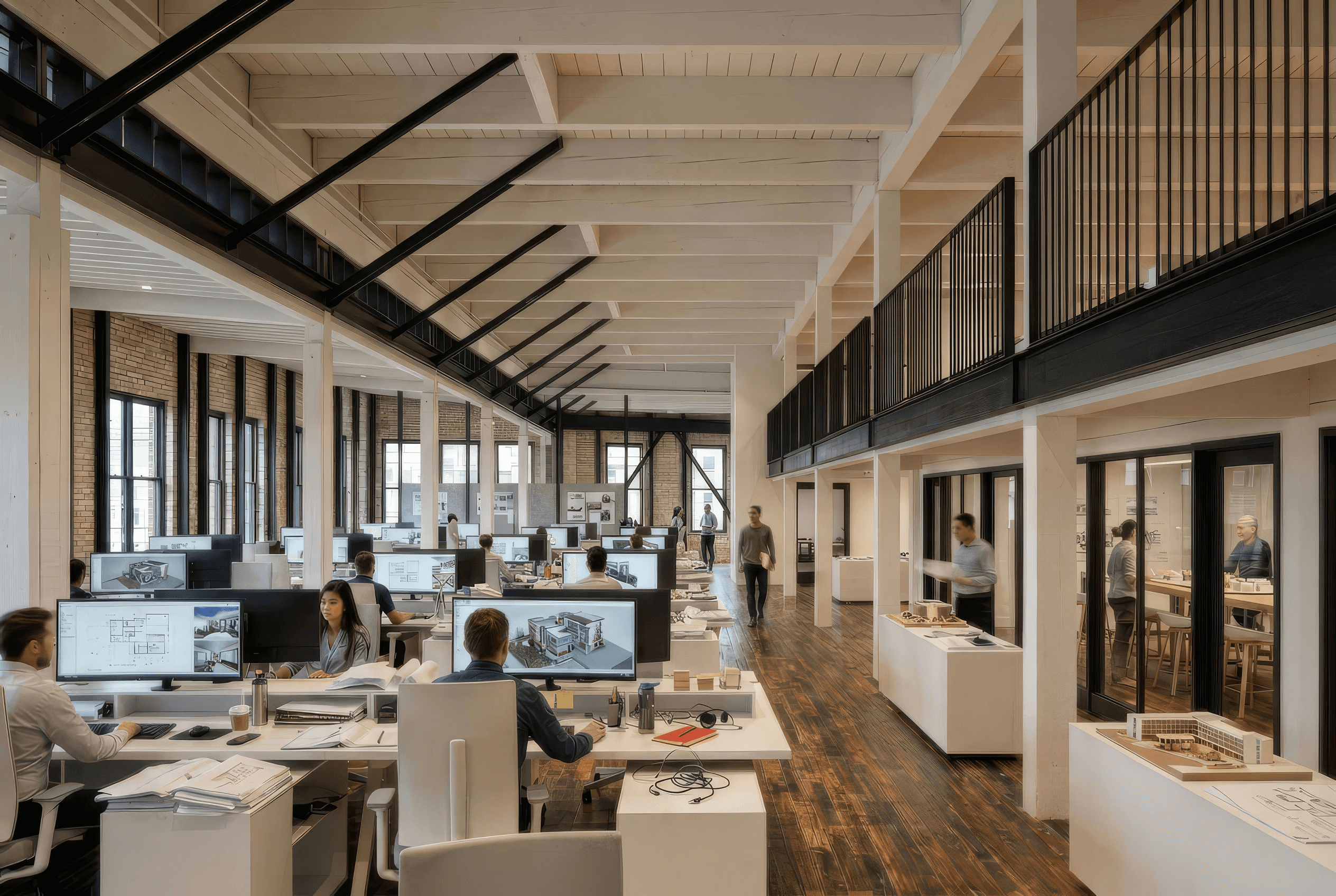
Here's what that looks like in practice. As LMN plans its own new office renovation, the team had a rough working model of a new layout, the kind of massing and furniture study that makes sense to the people who've been staring at the project for weeks and means almost nothing to anyone else. Team members ran a basic render capture through FLORA, and in about half a minute, that generic model became a rendering anyone could read at a glance.
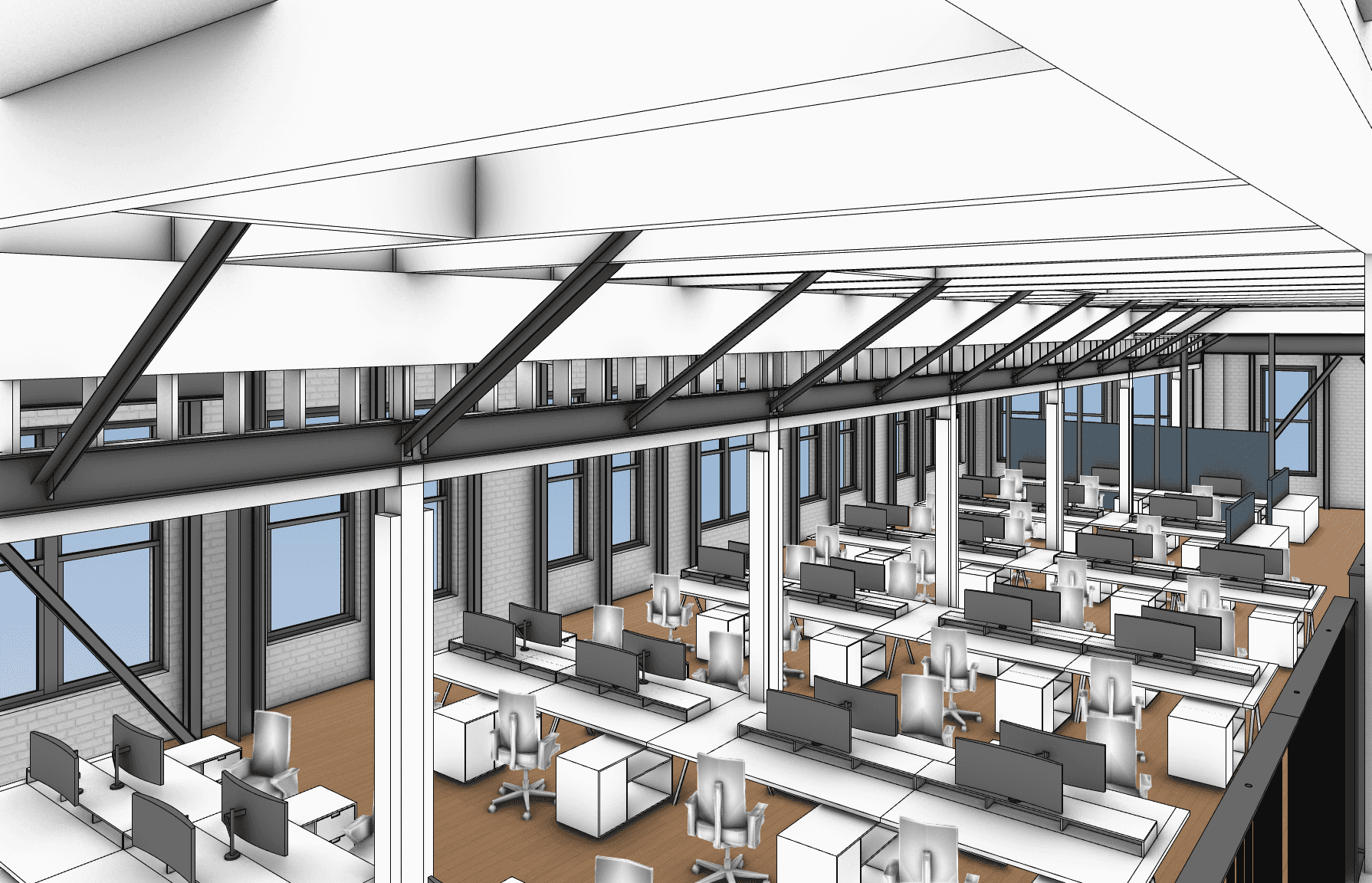
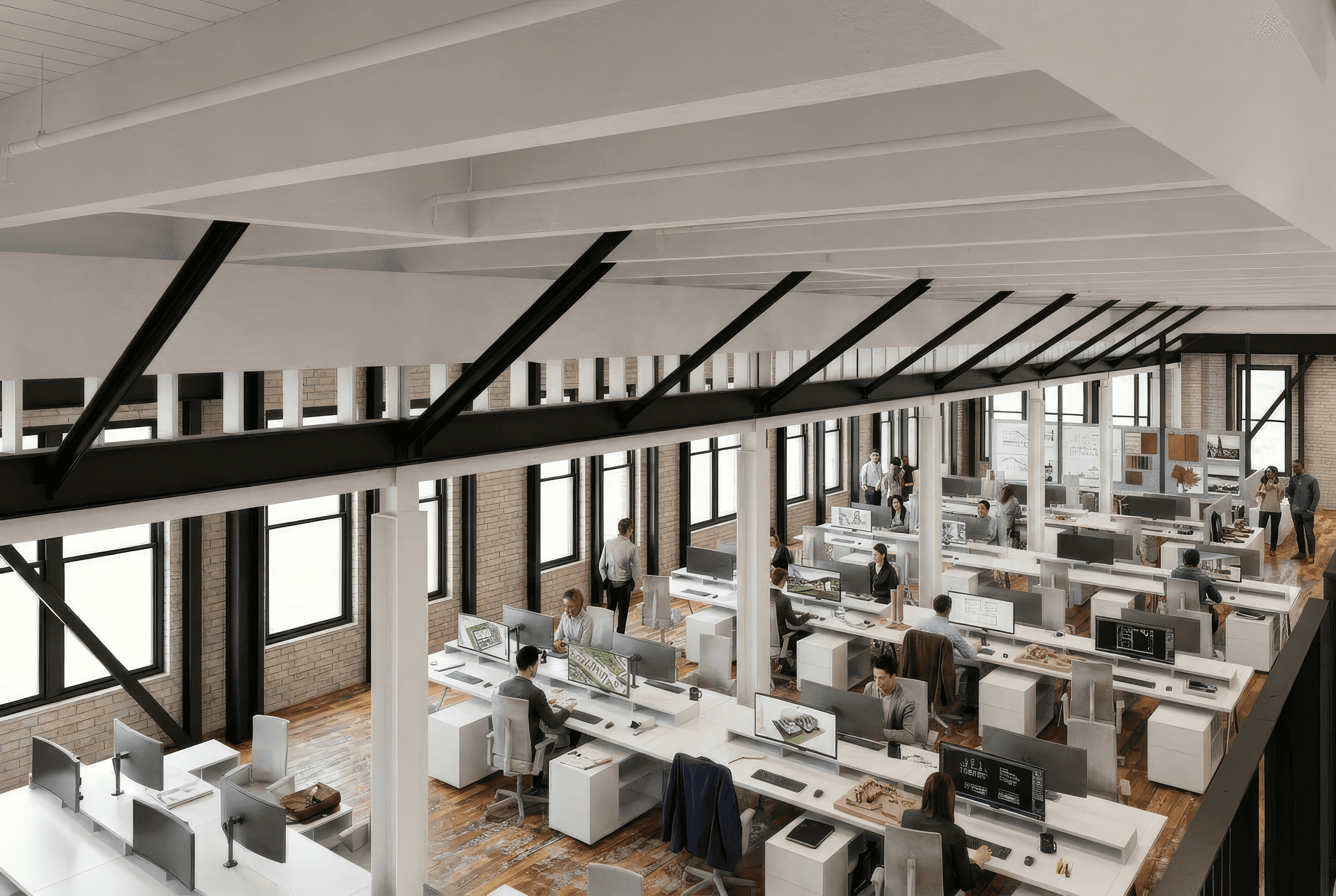
What has made this use case interesting is that LMN was both designer and client at once. The team got to sit on both sides of the table in a way that almost never happens on a real project.
As designers, they were pushing the layout forward, testing instincts, deciding what was worth pursuing. As the client, they were the ones seeing the render cold, reacting the way any occupant would, with the same skepticism and gut-level sense of whether it actually worked for them that clients bring.
Watching those two reactions happen in the same room, sometimes with the same person, says a lot about why the tool matters. It's not just about the designer moving faster, it's about closing the gap between what a designer sees in a rough model and what everyone else needs to see to respond to it.
That render went to firm leadership as a rough sketch, not a finished proposal. It opened a real conversation, and that conversation told the team where to take the layout. The project team used that back-and-forth to make real decisions: what to commit real time to, what to drop, what needed an actual model. Once the idea held up, it got shared out to the rest of the office. Used this way, FLORA isn't about replacing the design process. It's about giving that process a way to talk to people who aren't inside it yet, before real time gets spent.
What actually changed downstream
The effects from FLORA are quiet, but real.
Schematic design doesn't finish faster, since there's no shortcut through the actual thinking, but it finishes clearer.
Teams move into the next phase with shared intent instead of three different mental pictures of the same room.
That clarity carries forward: fewer surprises late in design development, fewer revision requests once construction starts.
It also flattens an old hierarchy. Rendering used to be a privilege of teams big enough to staff a visualizer. Now the smallest teams can do it themselves.
"A small team of three people can now get renders for themselves," Bryant says. "They have this thing they can go to and say, I want to generate an image, and the result is actually useful."
That access is what Bryant says he'd miss most if FLORA went away. "It's single-handedly one of the most important impacts on this office. How we're visualizing things, and giving people access to it."
Designing workflows around AI
LMN doesn't describe this as adopting AI. They describe it as building workflows around what AI is good at. "There's a lot of fear in this industry," Bryant says. "People worry it'll replace them."
The studio treats FLORA the way it treats its other computational tools, as an extension of the team's own thinking rather than a button you press to skip the work. "We've always asked how we want to use this," Bryant says. "Not how everyone else is using it."
Ask architects what worries them about AI and the answer is rarely their jobs. It's the buildings. It's the floor-plan generators and one-click renderers that flatten design into interchangeable, developer-grade boxes, waved through for the sake of speed.
Bryant Callahan has heard that fear plenty. He runs the tech studio at LMN Architects, and his response runs the other way. "We don't want to compress so we can do more projects. We want to improve the quality of work on the projects we have. This lets us actually design."
That tracks with how the Seattle-based LMN operates. They were early on 3D printing, CNC fabrication, and computational design, usually before the rest of the industry moved. "Architecture and engineering tends to lag," Bryant says. "It's so governed by construction, and construction is risk-averse." LMN's instinct runs the other way: try the thing while it's still a little risky, then work out what it's actually for.
LMN can afford that instinct because of what it's achieved: nearly 300 design awards, the 2016 AIA Architecture Firm Award, and a portfolio that runs from the Washington State Convention Center expansion to the Seattle Aquarium's Ocean Pavilion. Architecture, urban design, landscape, interiors, and public art all sit in one studio and turn up on every project. Clients come to LMN when a building has to carry a lot of cultural weight at once, which as it turned out, put a lot of pressure on rendering.
Clients see something as it is
Civic projects generate an enormous amount of visualization. Schematic design runs for months, and at every milestone a team has to turn a still-changing idea into something a city council or a museum board can react to.
For decades, the process worked one way. You designed in 3D, modeled in Enscape or Revit, then late and under deadline, two specialists in 3ds Max produced a polished image for the presentation. It worked, but it also created three problems:
Rendering came too late to act on
Lean teams couldn't afford it
Early polish froze decisions before they were made.
"Clients can immediately start asking, why are the lights like this? Why is the ground like this?" Bryant says. "Designers understand everything is malleable. Clients see something as it looks, in that moment."
A finished-looking render at the schematic stage pulls the conversation toward finishes and polish, when it should still be about feeling, scale, and intent. LMN had been chipping at this for years, cycling through all the node-based tools (ComfyUI, etc) and Midjourney back when it was a Discord channel. None stuck. Local models were unstable under deadline, and most generative tools were black boxes: type a prompt, get an image, which is the opposite of how a design team thinks.
Why FLORA held up
Two things made the difference, and both are less glamorous than they sound.
First was reliability. "We're at a deadline," Bryant says. "You want something that opens up and just runs." It's the boring prerequisite for any tool entering a professional workflow, and where most generative tools fall down.
Second was fit. FLORA adapted to how the studio already worked, instead of the reverse. Jeff, a designer in the studio, became one of the first power users by sketching instead of typing prompts, using a hand drawing as the fastest way to tell the tool what he meant. When the team flagged that copy-paste was clunky, it got fixed. When Jeff's sketch-over method took hold, FLORA leaned into it.
"Picking software often feels like picking the least-worst option," Bryant says. "It's nice to feel like our input had an impact, and that there's recognition of the unique way we work."
Feeling the magic of FLORA
Jeff's process is a loop. He exports a clay model from Enscape, sketches over it (by hand, in Photoshop, sometimes with a finger on his phone) to suggest material, light, or a specific move, then feeds it into FLORA and prompts through a few iterations. Sometimes it ends there, with an internal render that gets the team aligned. Other times it runs back through Photoshop and FLORA again before going to the client. "It's not a linear workflow," Jeff says. "There's a start and an end, but a lot of looping back in between."
Bryant frames it as "multimodal by design": model, export, sketch, render, print, mark up, re-model. "You gain design insight by changing from one form to another and back again."
Here's what that looks like in practice. As LMN plans its own new office renovation, the team had a rough working model of a new layout, the kind of massing and furniture study that makes sense to the people who've been staring at the project for weeks and means almost nothing to anyone else. Team members ran a basic render capture through FLORA, and in about half a minute, that generic model became a rendering anyone could read at a glance.
What has made this use case interesting is that LMN was both designer and client at once. The team got to sit on both sides of the table in a way that almost never happens on a real project.
As designers, they were pushing the layout forward, testing instincts, deciding what was worth pursuing. As the client, they were the ones seeing the render cold, reacting the way any occupant would, with the same skepticism and gut-level sense of whether it actually worked for them that clients bring.
Watching those two reactions happen in the same room, sometimes with the same person, says a lot about why the tool matters. It's not just about the designer moving faster, it's about closing the gap between what a designer sees in a rough model and what everyone else needs to see to respond to it.
That render went to firm leadership as a rough sketch, not a finished proposal. It opened a real conversation, and that conversation told the team where to take the layout. The project team used that back-and-forth to make real decisions: what to commit real time to, what to drop, what needed an actual model. Once the idea held up, it got shared out to the rest of the office. Used this way, FLORA isn't about replacing the design process. It's about giving that process a way to talk to people who aren't inside it yet, before real time gets spent.
What actually changed downstream
The effects from FLORA are quiet, but real.
Schematic design doesn't finish faster, since there's no shortcut through the actual thinking, but it finishes clearer.
Teams move into the next phase with shared intent instead of three different mental pictures of the same room.
That clarity carries forward: fewer surprises late in design development, fewer revision requests once construction starts.
It also flattens an old hierarchy. Rendering used to be a privilege of teams big enough to staff a visualizer. Now the smallest teams can do it themselves.
"A small team of three people can now get renders for themselves," Bryant says. "They have this thing they can go to and say, I want to generate an image, and the result is actually useful."
That access is what Bryant says he'd miss most if FLORA went away. "It's single-handedly one of the most important impacts on this office. How we're visualizing things, and giving people access to it."
Designing workflows around AI
LMN doesn't describe this as adopting AI. They describe it as building workflows around what AI is good at. "There's a lot of fear in this industry," Bryant says. "People worry it'll replace them."
The studio treats FLORA the way it treats its other computational tools, as an extension of the team's own thinking rather than a button you press to skip the work. "We've always asked how we want to use this," Bryant says. "Not how everyone else is using it."